

In 1998, at the age of eleven, I spent most of my time in my father's sign-painting shop. To earn some cash, I would create logo stencils of popular basketball teams like the Chicago Bulls or famous rapper Tupac Shakur, and sports icons like Zinedine Zidane, using old radiographic films. With a can of spray paint in hand, I'd then tag up my friends' basketball boards, town walls, or even their clothes. Every year, right beforeIranian New Year's, I would become the neighborhood's unofficial fireworks dealer, selling illegal pyrotechnics for a considerable profit. And then there was my illegal movie-selling business. Equipped with a VCR and stacks of legal Iranian movie video tapes, I would record the latest Hollywood movies onto these tapes and rent them out to friends and neighbors, all while avoiding getting into trouble. I made some decent cash out of Titanic or famous rock concert film Monsters in Moscow years after their initial release. Sure, some of my ventures may have been a bit shady, but kids’ gotta hustle. There were other options like Taekwondo or wrestling classes, well, they just didn't seem as lucrative.
At the bottom of all these activities, nothing was as mesmerizing to my crowd and me as the screen of those old-school TVs and going to video gaming clubs, which in Farsi we call Kooloop. We immersed ourselves in the world of 'the Other' through PlayStation games. We lived in a drab town where everything was in shades of gray, overly monotonous. We were naive enough to believe that these games represented a real modern Western world, not just their fantasy. Everything other than us seemed Western, and the East had no foreign presence. It was not that hard to think that they lived in this dreamy world as portrayed in video games and sent us images of it to validate it. Everything seemed authentic. We promptly appropriated this dream as our own. We could believe everything as UFOs started connecting more with Westerners than with us.
In the absence of a familiar language, the only means of communication was through the image. Our interpretation of the game's visuals was solely based on decoding the images themselves, without considering the game's storyline or any hints and guides provided by the game developers. The only English words we knew were "start" and "restart," but spotting them in Japanese video games was like looking for a single cherry blossom in a bonsai forest!
For that reason, playing games felt like a never-ending odyssey for us, going on much longer than you would imagine. Games that were supposed to be quick eight or nine-hour ventures turned into our daily and weekly routine. We would explore every nook and cranny, repeatedly pressing buttons in hopes of stumbling upon some hidden gem or unlocking a secret door. We were convinced the game designers were having a laugh, making these games intentionally tricky and complex. To us, every game was like a puzzle waiting to be solved, with hidden paths and secrets lurking around every corner. Every image on the screen, whether it was on a wall or a character's shirt, seemed to hold some mysterious significance that we were determined to uncover.
In 1998, the game "Resident Evil 2" was everyone's favorite. It had everything we wanted and needed: fear, excitement, monsters, weapons, and, most importantly, a captivating character without hijab. This game was so terrifying to us that no one dared to play it alone in front of the TV. At the club, the controller of the PlayStation always remained in the possession of the individual who had paid for the rental time, while their friends surrounded them. There was a real need to reduce this fear. Almost all decisions were made collectively. Should we enter this new room in the game or not? Even which plants and medicines to combine in the game to restore the character's health were decided collectively. It is no exaggeration to say that we spent as much time exploring a remedy in a computer game as a pharmacist does in real life. We had to discover everything through trial and error. Keep in mind that this only happened because of our lack of knowledge of the game's language; otherwise, we weren't dumb. We knew we had to move forward and finish the game. Visual logic and risk-taking were the keys to solving puzzles.
One of the puzzles in the game 'Resident Evil 2' was the scene called; A sacrifice to the hell fire. The game character entered a room with a fireplace, above which hung a painting of a naked woman with bound hands and a concealed face. To progress, the player had to ignite the fireplace using a lighter found elsewhere. Suddenly, the painting would ignite, revealing a red jewel that fell out. Imagine the energy and time it took for us to figure out, without any guidance or language knowledge, that we needed to use the lighter in this particular spot. We could pray, but which angel of the Islamic world is present to help a child find a lighter to set a painting of a naked woman on fire in the scene of a sacrifice to the hellfire?
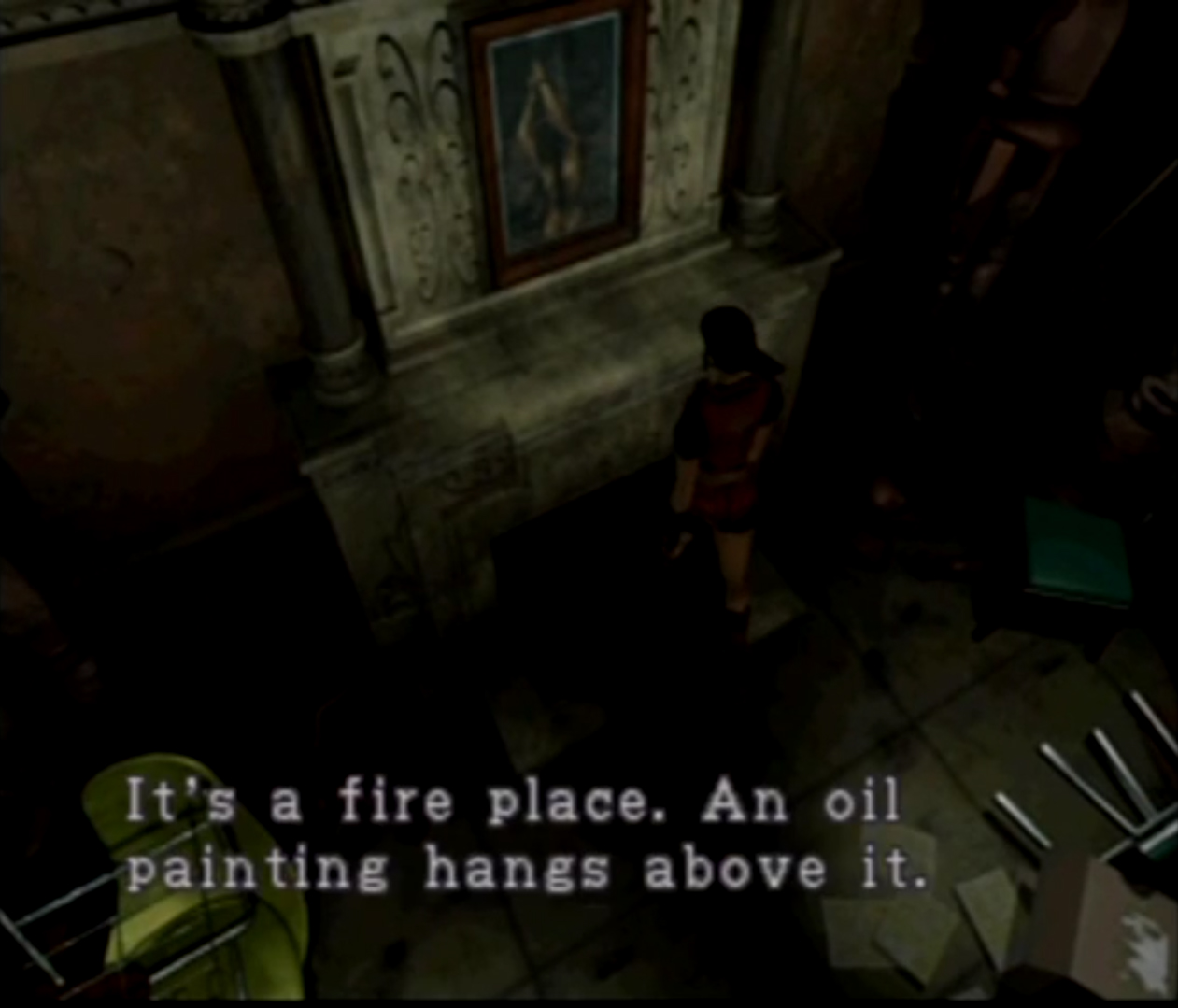 Resident Evil 2 Fire Place Puzzle Guide: https://www.youtube.com/watch?v=MMaebYBtmT8
The painting of a naked woman alone was enough to turn this riddle into the most beloved puzzle of this game for my generation. The painting of a naked woman in that room was essentially the first depiction of nudity we had ever seen. In the socially conservative backdrop of that era's Iran, this pixelated painting was excessively provocative. A painting where almost nothing was explicitly shown, yet we could see whatever we wanted, and our eyes acted like today's digital cameras and artificial intelligence technology, filling in the artificial pixels in between and enhancing the image quality in our imagination.
All that we witnessed in the images and the attire portrayed in these computer games was deemed satanic within the legal and somewhat cultural framework of Iran at that time, and our resident evil was stronger than easily casting it aside. Instinctively, we hadfound a way to communicate with images and, using this language, constructed our own understanding of the "other. " A being that had the ability to confront and combat the forces of evil in the world of video games. Our idea of the "other" became clearer over time. We accepted the otherness of the other. Whatever was within us had a natural will, and no force had the ability to resist this will and curiosity.
We lived in the midst of it all. We had no idea about our own culture, nor any understanding of the culture within video games. But we could sense the difference between the two. We had two worlds facing each other. On one side, every day in the school morning queue with sleepy eyes and minds barely awake, we listened to the principal's voice, Quranic sermons, and ideological anthems focused on Shia political Islam. On the other side, after school, once we safely escorted the neighborhood girls to their doorsteps, we headed straight to the club with a clear conscience. We chose a character in the world of video games and, to the best of our ability, engaged in exorcism, becoming the heroes of the neighborhood and the virtual world.
It is amusing how the political and cultural leaders of Iran were completely unaware of the impact of these types of video games on us. The revolutionaries, who had taken the place of the previous dictator, had defined their own version of radical political Islam and sought to build a thoroughly Islamic nation from head to toe, with us as their soldiers. They aimed to engage in battles with both external and imaginary enemies until the apocalypse, when we would all be saved. Oblivious to the fact, the real enemies were right within them, the same resident evils who sought new avenues for their creativity every day. Gradually, we came to believe that we needed to resemble characters from video games or musicians from metal bands in order to acquire new abilities. It's funny to know that the first time I bought ripped jeans, my mother looked at me in bewildered disbelief, thinking she had raised a fool who had fallen victim to a charlatan and insisted on returning them. My father was also concerned that a clown was going to be the father of his grandchildren. Don't get me wrong, they were the intellectuals of their own time.
My comrades and I, in our small cliques and colony-like gatherings, wholeheartedly endorsed each other's antics, reaching such audacious heights that paying the consequences for our deeds didn't faze us anymore. The black hole we found ourselves in seemed to illuminate our lives the most. Now was the time to say yes to the no. The sound we shouldn't perceive, the realms we shouldn't wander, and the loves we shouldn't kiss. Again, I emphasize, we weren't dumb! But we didn't know what we wereafter. We came to realize belatedly that this hidden lust and unrecognized longing bore the name of freedom.
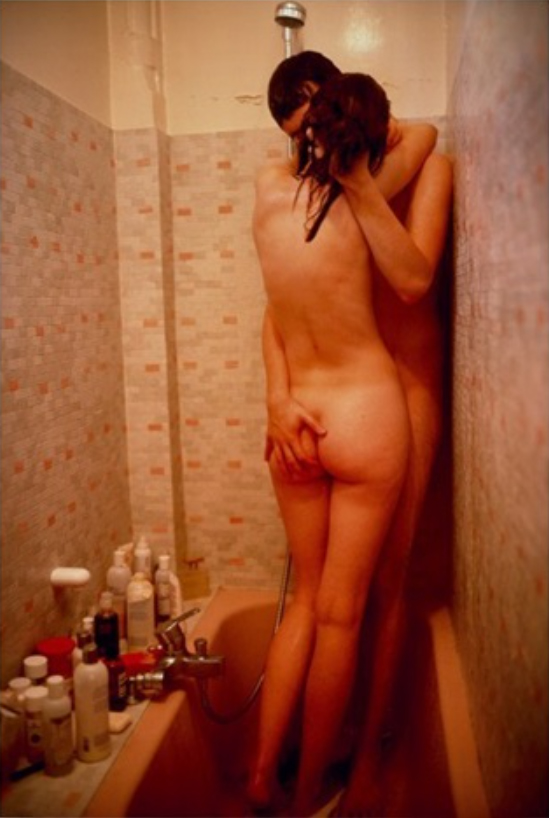
Nan Goldin, Simon and Jessica in the Shower, Paris, 2001, dye destruction print; 96.5 x 65.4 cm
Part 2
Around the years 2002 and 2003, low-quality versions of this image were passed around in Iranian chat rooms on Yahoo. They were roughly 4 by 6 centimeters in size. The scene depicted a man and a woman hugging in a bath. The titles used for this image were diverse, ranging from 'Young Iranian couple in the bathroom' to 'A boy taking his girlfriend to the bathroom,' and thousands of other titles. Even users from different cities added their city names into the captions. "Shirazi girl and boy in the bathroom". Guess the sharp sour versions. Pornographic films were not available on the internet. Internet speeds were between 32 to 64 kilobytes, making it challenging to download even a song, let alone a film, let alone a porn movie. Nude and semi-nude foreign images had just entered the internet space. From those early days, Iranian users' mindset on the internet was in search of local nude or porn examples. Perhaps the Farsi word Vatani which means national entered Iranian discourse during that period.
In 2008, for the second time, I accidentally came across this image, but not in chat rooms and websites where nude images were typically found. It was on a site with contemporary art content, possibly ArtNet. I was left stunned for a few minutes. Then, I read the title: "Simon and Jessica in the Shower, Paris, 2001 by Nan Goldin."
There were no signs in the picture that indicated any nationality. The image could easily have been from any bathroom anywhere in the world, but our young minds wanted this bathroom to be located in Iran. It was somewhat similar to Iranian bathrooms, and that was enough. The first person who sent this image to their friend likely sent a message similar to this: "Today I took my girlfriend to the bathroom." One can imagine the excitement it caused in an environment where the interaction between boys and girls was severely controlled by families, society, the police, and the government. It is also possible to imagine that an envious friend sent the picture to others for revenge, or they confiscated the image for themselves and sent it to another friend to mock them or participate in a pathetic game.
On the other hand, Jessica, in the picture, has no idea that she has been the subject of interest for hundreds of Iranian boys. How would her boyfriend, Simon, feel if he found out that thousands of fake Iranian men's names have been superimposed on him? Perhaps, if we exaggerate a bit, we can imagine that among the boys who stole Simon's identity, some may have even cut their hair short to resemble him, to make their story seem more authentic. Boys do everything!
I don't know if Simon and Jessica are still together. I don't even know if Simon and Jessica were ever partners. They could have just been together for one night, and that night was enough to capture this image. Maybe they were just regular friends, and the photographer asked them to embrace each other in the bathroom so she could capture a picture. Let's be more realistic. Sex under the shower is a hoax!
But our inclination in any photo is towards reality. We want to believe that this image is captured from a moment of intimacy or embracing between two lovers. The more intense the love between them, the more we will cherish this image. In a more ethical way, our inclination is towards reconstructing this moment with the person we love, not Jessica. If we look at the story this way, we understand that Iranian men who drew inspiration from this image and exercised their creativity may not have done anything that devilish.
I prefer to believe this moment is real, and we are siding with two real lovers. Then, I would like to know Simon and Jessica's opinions about this incident. How much envy and anger could possibly arise in Simon if he finds out that Jessica's picture has been misused by Iranian men? If Simon were aware of this incident, could his opinion about Jessica change? What is Jessica's own opinion? Does Jessica have a brother who would become angry seeing this picture of her being misused? How about Jessica's father? It doesn't seem like he would do something foolish. Which social class do Simon, Jessica, and their family belong to?
Probably the image taken of Jessica in Paris poses no danger to her. There is no danger for Simon or the photographer either. This image has also been presented in exhibitions, books, and other platforms, so Western institutions probably have no issue with it, and it's likely that legal and cultural powers won't allow them to have any issue with it. So where is the danger that we perceive? Where do jealousy and prejudice come into play in this story, and who are the victims of it: Simon and Jessica, whose image has been misused to falsely represent another person, or the women whose names were wrongly associated with Jessica's naked body for malicious purposes?
Lecture delivered at the Master of Fine Arts Symposium, “Gestures, Practices, and Strategies of Resistance – S.W.A.N.A.” at ECAL, Lausanne, in 2024.
